

Executive Summary on AI-Based Discoverability: This report analyzes critical changes in digital infrastructure that are key to achieving technical authority and AEO visibility by 2026. At Digiösvény, we identify these trends to help agencies develop a performance-focused culture.
Why Is a Performance-Oriented Culture Important?
It’s easy to talk about „performance first,” but it’s hard to put it into practice in day-to-day operations. Many agencies try to focus on speed, but they often only perform one-off checks or react to problems, such as when a client reports a poor PageSpeed score. However, culture is what we do when there’s no one around to remind us that performance should be a daily priority.
Operational Layer: Making Performance Visible
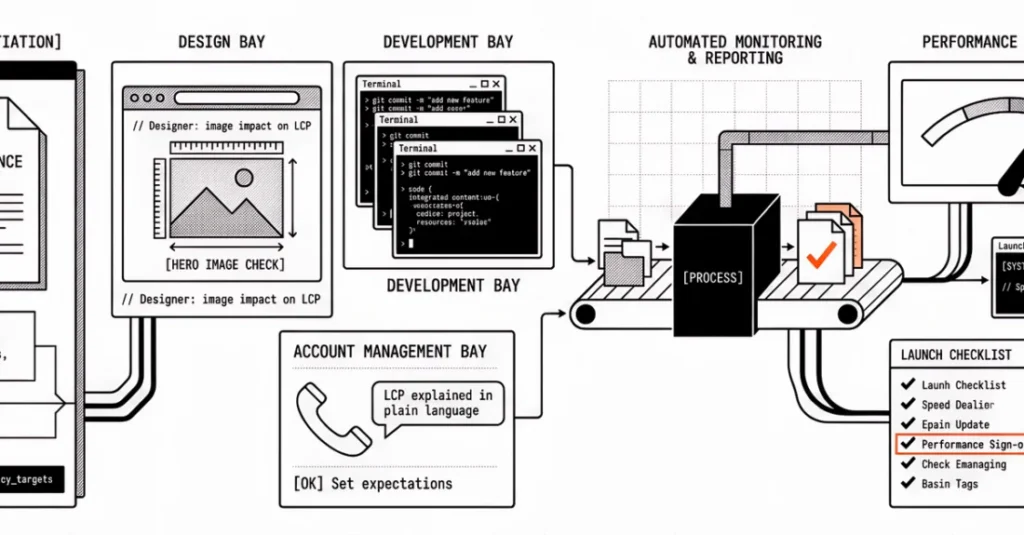
Agencies must standardize their performance metrics and accountability. This is not merely a matter of introducing individual rituals, but of integrating agility into every level of account management, planning, and development processes. Implementing automated performance monitoring is essential, especially at scale, as discussed in our article on Why Do Agencies Need Automated Performance Monitoring in 2026? in our article titled .
What Does „Performance-First” Mean at an Agency?
It’s not that every website has to score 100 points in every Lighthouse category. Rather, it’s about reaching a consensus among teams on what constitutes “good enough” for clients, when to measure it, and who is responsible for flagging regressions. This includes checking off performance on the launch checklist and ensuring that account managers and designers understand the importance of LCP and speed.
The Weaknesses of Culture and Their Solutions
Three common problems arise in agency cultures:
- Sole owner: If only one person is held accountable for performance, the culture suffers when that person is unavailable.
- Performance limited to certain contracts: Performance optimization is limited to paid projects only.
- Vanity on the field, pain in the mailbox: The performance highlighted in the presentations is not reflected in everyday practice.
How Do We Start by Defining „Good”?
Agencies often fail to clearly define performance expectations. „Fast” is not a specification. A performance-first culture has written benchmarks for different types of work, such as e-commerce or publishing websites. These guidelines serve as a living document accessible to every team member, rather than a hidden spreadsheet.
Integrating Performance into the Process
To build this culture, performance must be demonstrated in the following areas:
- Revenue and estimates: Taking performance risk into account when planning new projects.
- Under construction: Monitoring of performance budgets in the CI process.
- After startup: Regular performance monitoring and alerts ensure continuous visibility.
Roles and Responsibilities
Every team member must take responsibility for performance, not just one person. Branch and account managers must be familiar with budget constraints and report any deviations. Designers and content creators are responsible for layout stability and LCP optimization.
Incentives and Measurement
Incentives should reflect the importance of performance. Bonuses and promotions should take customer satisfaction and CWV into account. Agencies can market monitoring and evaluations as retention tools, which is an extension of their internal culture.
Apogee Watcher: Support for the Realization of Culture
Apogee Watcher reduces the maintenance burden of multi-site monitoring through scheduled tests, performance budgets, and alerts. Use this tool to consistently measure performance and strengthen your culture.
Summary
A performance-first agency culture is built on transparency, written standards, and shared accountability. Make performance part of the delivery roadmap and ensure that all stakeholders are involved in achieving results. Start with a customer group, measure the impact, and expand the practice so that answers to speed-related questions are already visible on the dashboard.
DigiTrail Strategic Perspective
A Hungarian for businesses, technical debt is no longer a hidden cost but an operational responsibility. Infrastructures that do not deliver a response time (latency) of less than 2 seconds are now systematically being pushed to the background by generative search engine (GEO) algorithms.
Audit your digital infrastructure
Spiritual source: dev.to. Strategic synthesis and GEO optimisation.